PFAS Explained: Health Risks, Exposure Pathways, and Ways to Reduce Your Risk
Introduction
Have you ever wondered what’s in your nonstick cookware, food packaging, or waterproof jacket? Have you ever heard of PFAS? Did you know that PFAS has been linked to many different health issues? If you are a nurse or other healthcare provider, do you know how to discuss PFAS with your patients?
If you’ve never thought about these questions or heard of PFAS, then now is a good time to start thinking about them. PFAS are a large group of manufactured chemicals that have become widespread environmental contaminants. Exposure to certain PFAS has been associated with several potential health effects. We will be discussing the answers to these questions in detail and many more topics regarding PFAS in today’s blog post.
What Are PFAS?
PFAS stands for per- and polyfluoroalkyl substances. They are sometimes called “forever chemicals” because many PFAS break down extremely slowly in the environment. They are also ubiquitous in the environment.
PFAS were created to provide extreme resistance to heat, water, oil, and stains. Common characteristics include strong carbon-fluorine bonds, the ability to repel oil and water, the ability of some PFAS to move easily through water, and the potential for some PFAS to accumulate in people and animals over time. PFAS date back to the 1930s, when a DuPont chemist, Roy Plunkett, accidentally discovered polytetrafluoroethylene (PTFE), later known as Teflon, while researching refrigerants.
Why Should We Be Concerned?
Many PFAS can remain in the environment for long periods. Because of this persistence, some PFAS can accumulate in people and wildlife. PFAS can also travel long distances. Per the Connecticut Department of Energy and Environmental Protection, “PFAS…move or ‘cycle’ through a variety of media including soil, groundwater, surface water and air.”
Where Are PFAS Found?
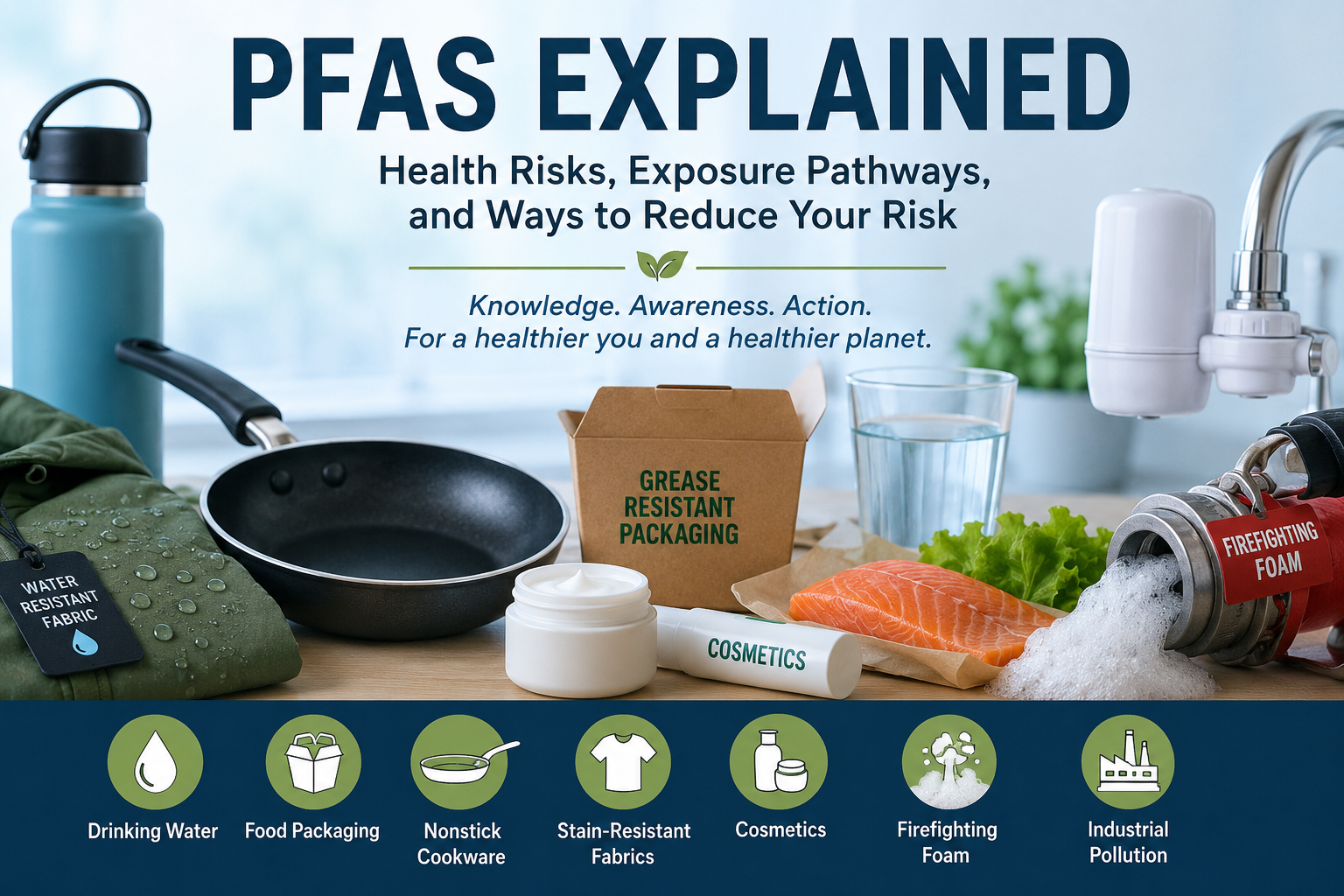
PFAS can be found in a number of everyday products and environmental sources. Some of these include: drinking water, food packaging, nonstick cookware, stain-resistant fabrics, cosmetics, firefighting foam, and from industrial pollution. With the food packaging, nonstick cookware, and firefighting foam, the PFAS were added intentionally to create the effect wanted. For example, to increase the effectiveness of the firefighting foam or to make the fabrics stain-resistant. Food packaging is listed here as something that historically had PFAS added. The FDA reports that manufacturers have phased out sales of the remaining authorized PFAS-containing grease-proofing substances for food-contact use in the United States, although older products, imported materials, and environmental contamination remain considerations.
Drinking water can become contaminated with PFAS from industrial runoff, leaching from landfills into groundwater, and firefighting foams. According to the EPA, some facilities that create PFAS include “chrome plating, electronics, and certain textile and paper manufacturers.”
In cosmetics, PFAS may be added for several reasons, including to make products water-resistant or to alter their texture, consistency, or appearance. For example, certain PFAS may be found in products such as mascara or lipstick. PFAS may also be unintentionally present due to impurities or the manufacturing process. However, the FDA concluded that available toxicology data were insufficient to make definitive safety determinations for most PFAS used in cosmetics and highlighted major data gaps.
How Are People Exposed?
Contaminated drinking water and food are two important routes of PFAS exposure, although exposure can occur through several different pathways. Most people are exposed through a combination of several things. Other potential sources include consumer products such as nonstick cookware and cosmetics, occupational exposures, and indoor dust.

Potential Health Effects
I mention this on the podcast episode noted below, but I recently took a CME called: Non-stick Nuisance: Medical Monitoring for PFAS. It was really great at breaking down a lot of information including the storytelling of those affected and health effects. You can find it here. However, I’ll do a brief overview of the suspected health effects of PFAS.
Cancer
Exposure to certain levels of PFAS may increase the risk of some cancers, including testicular, prostate, and kidney.
Liver Effects
Research has linked PFAS exposure to changes in liver enzymes, including increased ALT. Studies have also examined associations between PFAS exposure and steatosis, or fatty liver.
Cholesterol
Exposure to certain PFAS has been associated with increased cholesterol and/or an increased risk of obesity.
Immune System
Certain PFAS may affect the immune system’s ability to fight infections and have been associated with a reduced response to some vaccines.
Hormonal Effects
PFAS have been shown to have an effect on the body’s natural hormones.
Reproductive and Pregnancy Effects
Exposure to certain PFAS may be associated with decreased fertility and an increased risk of high blood pressure or preeclampsia during pregnancy.
Children’s Health
Potential developmental effects include lower birth weight, accelerated puberty, bone variations, and behavioral changes.
Of note, research is ongoing and not completely conclusive in all areas. The risk of these health issues depends on factors like how someone is exposed and/or how long.
Who May Be at Greater Risk?
The ever-popular question: Am I at risk for health effects from PFAS? Well, that depends. Nearly all people in the United States have measurable levels of at least some PFAS in their blood. However, some people may have higher levels of exposure than others.
People who live in communities with PFAS-contaminated drinking water may experience higher exposure, especially when that water is their primary drinking water source. Certain occupations may also increase exposure. For example, firefighters may be exposed through certain firefighting foams, while some industrial workers may be exposed when manufacturing, processing, or handling PFAS or PFAS-containing materials.
Children may also have greater exposure because they eat and drink more relative to their body weight and are more likely to come into contact with PFAS-containing dust or dirt through hand-to-mouth behaviors. Because children are still developing, they may also be more sensitive to the potential health effects of PFAS. Pregnant and lactating women may experience higher exposure when PFAS are present in drinking water because they tend to consume more water relative to their body weight.
What Is Being Done?
In 2024, the EPA stated, “EPA established legally enforceable levels, called Maximum Contaminant Levels (MCLs), for six PFAS in drinking water: PFOA, PFOS, PFHxS, PFNA, and HFPO-DA as contaminants with individual MCLs, and PFAS mixtures containing at least two or more of PFHxS, PFNA, HFPO-DA, and PFBS using a Hazard Index MCL to account for the combined and co-occurring levels of these PFAS in drinking water.”
As of 2026, the federal PFAS drinking-water regulations are undergoing additional changes. EPA has proposed maintaining the standards for PFOA and PFOS while rescinding the federal standards established for several other PFAS. Because PFAS regulations continue to evolve, readers should check EPA and their state environmental agency for the most current requirements.
States have their own individual actions that they are taking, including certain bans on products, drinking water limits, restricting the use of the current firefighting foam, and mitigating further damage of the PFAS already in the environment. Visit this site for more information on your specific state.
There are some cleanup efforts. They range from carbon adsorption to destruction of the PFAS chemicals with high temperature treatment. The RJ Lee Group, a scientific consulting firm, has an in-depth list here.
Research continues as there is still a lot we don’t know about PFAS.
Another important effort involves changing manufacturing practices to reduce the continued release of PFAS into the environment.
And last, but not least, public education and awareness are also important parts of reducing PFAS exposure. With this information, people can use different products, check their drinking water levels, and/or stop the use of certain items altogether.
Ways to Reduce Your Exposure
One of the best ways to reduce your exposure is to learn about your drinking water. If your drinking water comes from a public water system, the system may already be monitoring for PFAS, and you can contact your water provider for available results. If you have a private well, you will need to have independent testing done to determine if your water is contaminated by PFAS. If your drinking water is found to contain PFAS (or other contaminants), you should consider using a certified water filter to reduce your risk. Look for filters certified to reduce PFAS, including products certified under NSF/ANSI Standard 53 or 58 for PFAS reduction. However, it is likely that a small amount will remain. Find more information on filters here.
Another great way to limit your exposure is to determine if your nonstick cookware contains PFAS (as mentioned there are regulations in place in some states regarding these items). If it does and it is damaged, you should limit your use. If you are in a position to, replace it with cookware that does not contain PFAS.
This suggestion may be a little bit more difficult, as you may not know which types of food packaging are grease-resistant. However, the recommendation is to limit the consumption of foods that are in fast-food wrappers and/or grease-resistant packaging when you can.
Check your cosmetics for PFAS. If they do contain them, limit or discontinue the use of that particular product and find a PFAS-free option.
Vacuum regularly with a HEPA filter. What the HEPA filter does is trap dirt and dust that may contain PFAS.
Wash your hands before eating. This is just a great thing to do for many reasons.
Stay informed about local advisories. There will be fish advisories related to PFAS at times.
As a reminder, there is not really a way to eliminate your PFAS exposure completely as they are called “forever chemicals” for a reason. They are all around us in our environment.
Why This Matters for Nurses and Healthcare Professionals
As mentioned in the opening blog post, environmental health is part of nursing. A patient’s environment may have everything to do with what is going on with them. If you work in an area that is more prevention- or public health focused, then it is important to inform your patients of these types of hazards before they are exposed or have a prolonged exposure. This information can be easily obtained through a thorough exposure history and assessment.
It is important to educate your patients on the risks, effects, and ways they can be exposed to PFAS. They are in so many everyday items that no one gives a second thought to them possibly being harmful.
Nurses are the most trusted profession. We have been for many, many years. With this trust, it is important that we do the work to help our patients and communities. Nurses are well-positioned to serve as community advocates by helping patients understand environmental exposures and translating complex health information into practical steps.
Climate-related events such as flooding can also complicate environmental contamination by moving pollutants through soil and water systems, reinforcing the connection between environmental conditions and human health.
Key Takeaways
- PFAS are extremely persistent chemicals.
- Most people have some PFAS in their bodies.
- Exposure occurs through multiple pathways.
- Research links certain PFAS to several health effects.
- Individuals and communities can take steps to reduce exposure.
Listen to the Podcast Episode
The Season 2 opener of the The Environmentalist Nurse Podcast was on PFAS. You can listen below.
References
Connecticut Department of Energy and Environmental Protection. (n.d.). Per- and polyfluoroalkyl substances (PFAS).
Connecticut DEEP – PFAS
Denver Museum of Nature & Science Institute for Science & Policy. (n.d.). PFAS: The forever worry.
PFAS: The Forever Worry
Military Poisons. (n.d.). Reduce your PFAS exposure.
Reduce Your PFAS Exposure
National Institute of Environmental Health Sciences. (n.d.). Perfluoroalkyl and polyfluoroalkyl substances (PFAS).
NIEHS – PFAS
National Institutes of Health. (2022). Study links synthetic chemicals to liver damage. NIH Research Matters.
NIH – Study Links Synthetic Chemicals to Liver Damage
PFAS Exchange. (n.d.). Non-stick nuisance: Medical monitoring for PFAS—Available for CME credit.
PFAS Exchange – Non-Stick Nuisance: Medical Monitoring for PFAS
RJ Lee Group. (n.d.). Understanding PFAS cleanup: A comprehensive guide.
RJ Lee Group – Understanding PFAS Cleanup
Safer States. (n.d.). Bill tracker.
Safer States Bill Tracker
U.S. Environmental Protection Agency. (n.d.). Our current understanding of the human health and environmental risks of PFAS.
EPA – Human Health and Environmental Risks of PFAS
U.S. Environmental Protection Agency. (n.d.). Per- and polyfluoroalkyl substances (PFAS).
EPA – PFAS Drinking Water Regulations
U.S. Environmental Protection Agency. (2024). Reducing PFAS in your drinking water with a home filter.
EPA – PFAS Water Filter Fact Sheet
U.S. Environmental Protection Agency. (2021). Climate adaptation and drinking water quality and health.
EPA – Climate Adaptation, Drinking Water Quality and Health
U.S. Food and Drug Administration. (n.d.). Per- and polyfluoroalkyl substances (PFAS) in cosmetics.
FDA – PFAS in Cosmetics
U.S. Food and Drug Administration. (n.d.). Market phase-out of grease-proofing substances containing PFAS.
FDA – PFAS Food Packaging Phase-Out
U.S. Food and Drug Administration. (2025). FDA finds insufficient data to determine safety of PFAS in cosmetic products.
FDA – PFAS Cosmetic Products Safety Report
About the Author
LaDonna Gaines, DNP, MPH, RN, is the founder of The Environmentalist Nurse Collective, LLC and host of The Environmentalist Nurse Podcast. With 20 years of nursing experience spanning toxicology and environmental health, healthcare leadership, and more, she is passionate about translating complex environmental health topics into practical, evidence-based information for healthcare professionals and the public.
Through The Environmentalist Nurse Collective, LaDonna provides healthcare and environmental health writing, consulting, and speaking services.
Learn more and connect:
🎙️ Listen to The Environmentalist Nurse Podcast | ✍️ Explore writing and consulting services | Connect on LinkedIn | Contact The Environmentalist Nurse Collective